
Sweetgum trees are everywhere in Cobb County, and their spiky seed pods — locally called “gumballs” — are one of the most underrated causes of gutter damage in the area. If you’re dealing with overflowing gutters every fall, there’s a good chance a sweetgum tree is the culprit. This guide breaks down why these pods are so damaging, how to spot the warning signs, and what actually works for gutter cleaning in Kennesaw when sweetgum debris is involved.
Table of Contents
Why Sweetgum Pods Are Uniquely Bad for Kennesaw Gutters
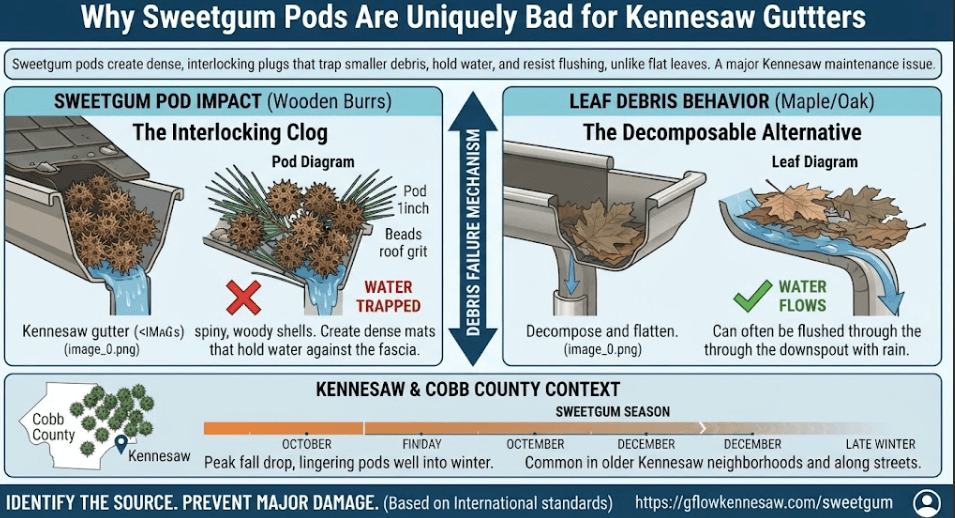
Quick answer: Sweetgum seed pods clog gutters faster than leaves because their spiny, woody shells don’t decompose or flatten the way foliage does. They wedge into downspout openings, trap smaller debris like pine needles and grit, and create dense mats that hold water against the fascia board. In Kennesaw, where sweetgum trees are common in older neighborhoods and along tree-lined streets, this problem shows up almost every October through December, with lingering pods still falling well into late winter.
Unlike maple or oak leaves, which break down and can be flushed through a downspout with enough rain, sweetgum pods are essentially small wooden burrs about an inch in diameter. Each one is hard, round, and covered in dozens of pointed spikes. When a handful collects in a gutter run, they interlock with each other and with twigs, pine straw, and roof grit, forming a plug that water simply cannot get past.
How the Clogging Actually Happens
Sweetgum trees drop pods over an extended window rather than all at once, which is part of what makes them so troublesome. A single mature tree can shed thousands of pods across a season, and they keep falling through wind events long after the tree has technically finished its cycle. For a Kennesaw home with two or three sweetgum trees nearby, that means gutters can go from clear to fully blocked in a matter of weeks.
Once pods settle into a gutter channel, here’s the typical progression:
- Pods collect at low points and near downspout openings, where the channel narrows.
- Rain washes finer debris (grit, pollen, pine needles) into the gaps between pods, packing the clog tighter.
- Standing water has nowhere to go, so it backs up along the entire gutter run.
- Overflow starts spilling behind the gutter and running down the fascia board instead of through the downspout.
- With repeated soaking, the fascia board begins to soften and rot, and in severe cases water intrudes into the roof deck or soffit.
This is why sweetgum debris tends to cause water damage faster than a comparable buildup of leaves. The pods physically block the drainage path rather than just slowing it down.
Warning Signs Your Gutters Are Compromised
Most Kennesaw homeowners don’t notice a sweetgum clog until water is already spilling over the edge. Watch for these earlier indicators instead:
- Visible mounds of pods sitting above the gutter lip, especially near corners and downspout drops.
- Water streaking on the siding or fascia after a moderate rain, which usually means overflow rather than a clean downspout release.
- Sagging gutter sections, since the added weight of waterlogged pods and debris can pull fasteners loose over time.
- Sprouting seedlings in the gutter itself — sweetgum seeds that have taken root in the trapped organic material.
- Pooling near the foundation, a sign that downspouts aren’t carrying water away from the home the way they should.
If you’re seeing two or more of these, it’s worth scheduling a cleaning before the next heavy rain rather than waiting for an active leak.
DIY Removal vs. Calling a Professional
Homeowners can manage light sweetgum debris with a stiff hand rake, gloves, and a garden hose, but this is genuinely one of the more physically demanding gutter jobs. The spiky shells make bare-hand removal painful, and because pods interlock rather than sitting loosely like leaves, a simple leaf blower often just pushes them around instead of clearing them out.
Professional appliance to the job includes pulling compacted mats by hand, flushing each downspout individually to clear internal blockages, and checking for downspout realignment where sections have shifted from the added weight. A trained crew will also inspect for early fascia board rot while they’re up there, which is easy to miss from the ground. For most two-story homes in Kennesaw with mature sweetgum trees nearby, professional gutter cleaning in Kennesaw twice a year — once in late fall after the main pod drop and again in late winter — keeps the system clear without letting debris compact into a harder-to-remove mass.
Do Gutter Guards Actually Help With Sweetgum Pods?
Gutter guards reduce the volume of debris that enters the channel, but sweetgum pods create a specific challenge: standard mesh guards with larger openings let smaller pods through, while very fine micro-mesh guards can get clogged on the surface by pods sitting on top and blocking water flow before it ever reaches the gutter. Guards designed with a solid surface-tension profile tend to perform better against sweetgum debris than basic screen types, but no guard eliminates the need for periodic inspection. If your property has sweetgum trees within reach of the roofline, guards should be treated as a maintenance reducer, not a replacement for scheduled cleaning.
Seasonal Timing for Kennesaw Properties
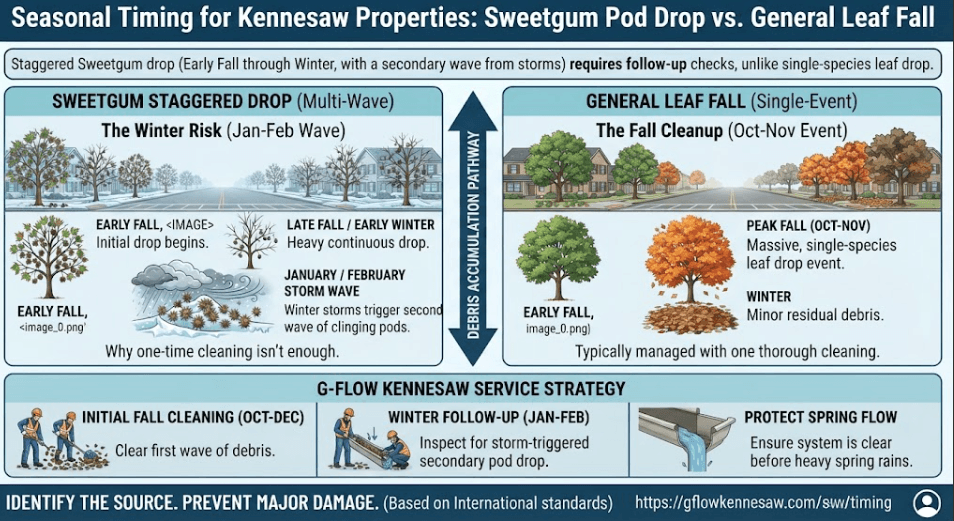
Sweetgum pods in the Kennesaw area typically begin dropping in early fall and continue through the winter, with a secondary wave often triggered by winter storms knocking loose the pods that clung on through the first frost. This staggered drop pattern is different from a single-species leaf drop, which is why a one-time fall cleaning often isn’t enough on properties with heavy sweetgum coverage. Planning for a follow-up check in January or February catches the second wave before spring rains put pressure on an already-loaded gutter system.
Preventing Long-Term Damage
Beyond regular cleaning, a few habits reduce the risk that sweetgum debris turns into a repair bill:
- Trim overhanging branches where practical to reduce the volume of pods landing directly in the gutter.
- Check downspout extensions each season to confirm water is discharging well away from the foundation.
- Have fascia and soffit areas inspected annually for soft spots, discoloration, or peeling paint, which often signal hidden moisture damage.
- Keep an eye on gutter hangers and brackets, since the added weight of trapped pods accelerates sagging over years of exposure.
For a deeper look at how roof drainage systems are supposed to perform, the USU Extension’s guide to sweetgum tree characteristics covers the tree’s fruiting pattern and growth habits in detail, and Cobb County’s own stormwater management FAQ outlines how residential drainage connects to the broader municipal system — useful context if overflow from clogged gutters is contributing to yard drainage issues.
If your gutters haven’t been checked since last spring, gflowkennesaw.com offers seasonal gutter cleaning in Kennesaw built around exactly this kind of debris load. The team handles everything from pod removal to downspout flushing, and can flag fascia or bracket issues before they turn into a bigger repair. For homeowners comparing options, professional Kennesaw appliance cleaning crews typically clear a sweetgum-heavy gutter run faster and more thoroughly than a weekend DIY attempt, simply because the compacted pods take specialized tools to remove without damaging the gutter itself.
Anyone serving the greater Kennesaw community with mature sweetgum trees on or near their property should treat gutter cleaning as a twice-yearly task rather than an annual one — the extended drop season makes a single cleaning insufficient more often than not.
Frequently Asked Questions
How often should I clean my gutters if I have sweetgum trees nearby?
Twice a year is the general recommendation for Kennesaw properties with mature sweetgum trees — once in late fall after the main pod drop, and again in late winter to catch the second wave that storms knock loose.
Can sweetgum pods actually break my gutters?
Yes, indirectly. The pods themselves don’t crack aluminum or vinyl gutters, but the added weight of waterlogged, compacted debris puts stress on hangers and brackets, which can cause sagging or pulled fasteners over time.
Will a leaf blower clear sweetgum pods from my gutters?
Not reliably. Because the pods interlock with each other and with finer debris, a blower tends to shift the pile around rather than clearing it. Hand removal or a wet/dry vacuum with a gutter attachment works better.
Do gutter guards stop sweetgum pods completely?
No guard is fully pod-proof. Standard mesh guards can let smaller pods through, and fine micro-mesh guards can get blocked on the surface. Guards reduce the volume of debris but don’t eliminate the need for periodic checks.
What does untreated sweetgum clogging eventually lead to?
Left unaddressed, trapped water can rot the fascia board, damage roof edge sheathing, and in some cases lead to interior water intrusion near the roofline. Foundation issues can also develop if downspouts stay blocked and water pools near the home’s base.
Is it normal to see seedlings growing in my gutters?
Yes — it’s actually one of the clearest signs of a long-standing clog. Sweetgum seeds germinate readily in trapped organic debris, and their presence usually means the buildup has been sitting for at least one full growing season.
Should I trim my sweetgum trees to reduce gutter clogging?
Trimming back branches that overhang the roofline reduces how many pods land directly in the gutter, though it won’t eliminate wind-blown debris from nearby trees. It’s a reasonable supplement to regular cleaning, not a substitute for it.