
Kennesaw’s stretch along the I-75 corridor has changed fast. New subdivisions, retail pads, and widened lanes have replaced grass and tree cover with asphalt and rooftops. That shift matters more than most homeowners realize, because it directly affects gutter drainage in Kennesaw properties sitting downhill or downstream from all that new pavement. When rain hits a parking lot instead of soil, it doesn’t soak in — it runs, and it runs fast, often straight toward your roofline and foundation.
Table of Contents
Quick Answer: How Is I-75 Development Changing Gutter Drainage in Kennesaw?
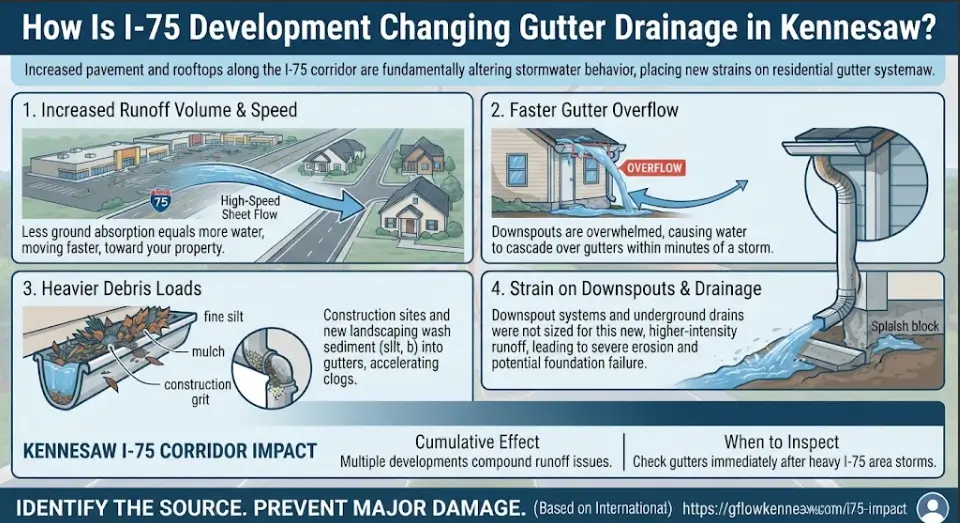
Increased pavement and rooftops along the I-75 corridor mean stormwater no longer absorbs into the ground the way it used to. Runoff volume and speed both go up, which pushes more water toward residential gutter systems in less time. Homes near new construction or widened roadways often see faster gutter overflow, heavier debris loads (silt, mulch, construction grit), and increased strain on downspouts that weren’t sized for today’s runoff levels.
Why Development Along I-75 Changes Local Water Behavior
Every acre of new pavement or rooftop is called an impervious surface — water can’t pass through it. Before development, Cobb County soil and tree canopy absorbed a large share of rainfall. Now, subdivisions and commercial pads near the interstate send that same rainfall downhill as surface runoff instead. Engineers refer to this as an increase in the impervious surface coefficient, and it’s one of the biggest reasons older neighborhoods near growth corridors report drainage problems they never had a decade ago.
This isn’t just theory. Georgia’s own stormwater guidance explains how converting natural land to impervious cover increases both the volume and speed of runoff, which is why municipalities require retention ponds and detention basins for new commercial builds near highways like I-75.
What This Means for Your Gutters and Downspouts
A gutter system installed 10-15 years ago was sized for the rainfall patterns and ground absorption of that era. Add new pavement uphill, and the same summer storm now delivers more water in a shorter window. Homeowners in growth-adjacent neighborhoods are seeing:
- Faster overflow during moderate storms — water spilling over the gutter edge before it can reach the downspout
- Sediment and silt buildup from construction sites and disturbed soil washing into open gutter runs
- Downspout backup where existing pipe diameter can’t move the added volume fast enough
- Soil erosion and pooling near the foundation where a downspout terminates too close to the house
- Fascia board rot from prolonged water contact when gutters run slower than the incoming volume
None of these are rare or unusual for the area right now — they’re a predictable result of upstream development, not a sign your gutters were installed poorly.
Seasonal Runoff Patterns Kennesaw Homeowners Should Watch
Georgia’s summer thunderstorm season (roughly May through August) delivers short, intense rain bursts — exactly the kind of rainfall that overwhelms a drainage system already handling extra runoff from nearby pavement. Winter brings a different problem: slower, longer soaking rains that saturate ground already compacted by nearby construction traffic, leaving less capacity to absorb overflow before it reaches your gutters and downspouts.
Tracking which storm type causes problems at your home helps a technician diagnose whether the fix is gutter capacity, downspout realignment, or a French drain extension away from the foundation.
Fixes That Actually Match Today’s Runoff Levels
Older 5-inch K-style gutters were standard for decades, but many homes near high-growth corridors are better served by 6-inch seamless gutters, which move roughly 40% more water per linear foot. Combine that with a few targeted upgrades:
- Upsize downspouts where overflow happens consistently at the same corner of the house
- Add downspout extensions or a French drain to move water well past the foundation, especially on sloped lots
- Install gutter guards to reduce sediment and debris intake from nearby disturbed soil
- Realign downspout placement if regrading from nearby construction changed your yard’s natural slope
- Schedule cleaning before storm season, since a partially clogged gutter fails far faster under high-volume runoff than a clean one
Signs Your Drainage System Is Already Overloaded
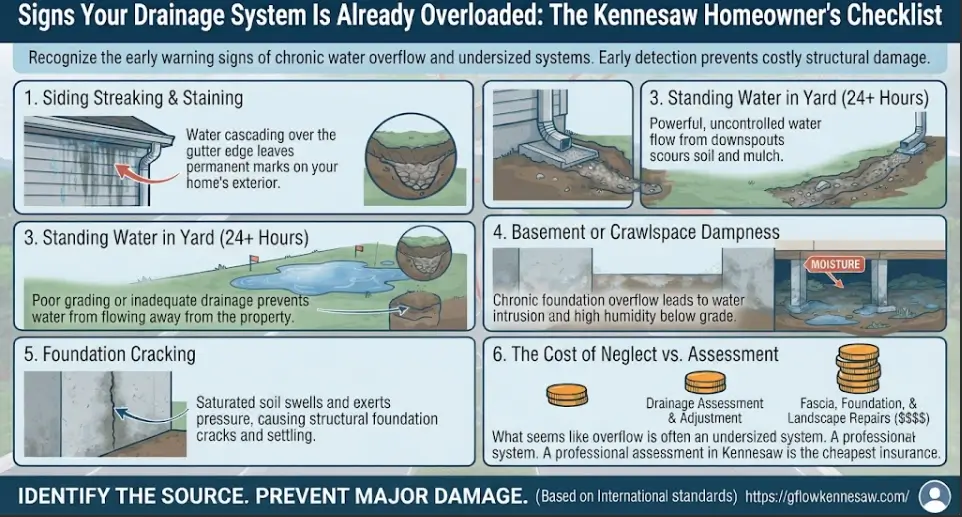
Watch for water marks or streaking on siding below the gutter line, soil washouts near downspout exits, standing water in the yard 24+ hours after rain, or a spike in basement or crawlspace dampness after storms. Any of these point to a system that’s undersized for current runoff conditions, not just a maintenance issue.
Left unaddressed, this kind of chronic overflow leads to fascia rot, foundation cracking, and landscape erosion — repairs that cost far more than a drainage adjustment would have. If you’re noticing any of these signs, gutter cleaning in Kennesaw paired with a drainage assessment is worth scheduling before the next heavy storm season rather than after damage shows up.
Homeowners who’ve had gutter cleaning services in Kennesaw done recently but are still seeing overflow are usually dealing with a volume problem, not a clog problem — which means the fix is capacity and routing, not just cleaning.
FAQs
Does new development near I-75 really affect drainage on my property?
Yes. Added pavement and rooftops upstream reduce natural ground absorption, sending more stormwater downhill as surface runoff. Homes below or near new construction typically see the effect first.
How do I know if my gutters are too small for current runoff levels?
Frequent overflow during moderate (not extreme) rainfall, water spilling over the front edge rather than draining through downspouts, and pooling near the foundation are the clearest signs.
Are 6-inch gutters worth switching to?
For homes near growth corridors handling higher runoff volumes, yes — 6-inch seamless gutters carry significantly more water per minute than standard 5-inch systems, reducing overflow during heavy storms.
Can construction sediment damage my gutter system?
It can. Silt and grit from nearby graded lots wash into open gutter runs and settle at low points, restricting flow and accelerating corrosion in metal gutters over time.
How often should gutters be cleaned in a high-growth area like Kennesaw?
Twice a year is standard, but properties near active construction or heavy tree cover often need a mid-season check, especially before summer thunderstorm season.
Will a downspout extension actually solve foundation pooling?
In most cases, yes — moving discharge 4-6 feet from the foundation prevents the repeated saturation that causes cracking and erosion, especially on regraded lots.