
Gutter cleaning in Kennesaw does more than keep leaves out of a trough. The red clay under your yard absorbs rain slowly and holds it for days. When a clogged gutter spills water beside the house, that clay stays soaked against your foundation. This guide explains how clay, gutters, and foundations interact, what warning signs to watch for, and what to do about them. G Flow Kennesaw serves the greater Kennesaw community, and the advice below applies to any home in the area.
Table of Contents
Why Gutter Cleaning in Kennesaw Matters More on Georgia Clay
Quick Answer: How does Georgia clay soil affect gutters and foundations?
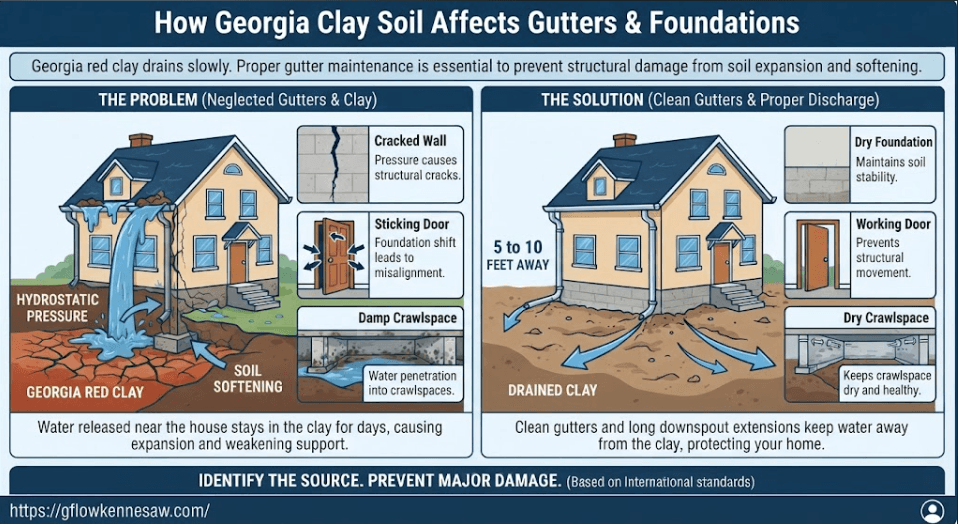
Georgia red clay drains slowly, so water released near your house stays in the soil for days. That water pushes against foundation walls, softens the ground under slabs and footings, and can lead to cracks, sticking doors, and damp crawlspaces. Clean gutters with downspouts that discharge 5 to 10 feet from the house keep that water away from the clay around your foundation.
What Makes Kennesaw’s Clay Different
Kennesaw sits in Georgia’s Piedmont region. The red soil here formed from granite and gneiss weathering in place, and the subsoil is dense and slow to drain. Cobb County soils are commonly Cecil-type clay. You can look up the soil type on your own lot with the USDA Web Soil Survey.
A few facts about this clay:
- It is not the most expansive clay in the country. Piedmont clay swells less than the clays in Texas or Colorado. The bigger problem here is that it stays saturated. A wet slope can sit heavy and muddy for days after a storm.
- It forms a hard crust when dry. Surface soil bakes and sheds water instead of absorbing it, so rain from a downspout runs along the surface toward the lowest point, which is often your foundation.
- Rainfall is heavy. Metro Atlanta gets roughly 50 inches a year, often in short, intense thunderstorms.
The roof adds to this. One inch of rain on 1,000 square feet of roof produces about 620 gallons of water. A 2,000-square-foot section of roof sends over 1,200 gallons through your gutters in a single inch of rain. If the gutters are clogged, all of that lands at the base of the wall.
How a Clogged Gutter Becomes a Foundation Problem
Foundation trouble starts with a handful of pine needles. The usual chain of events looks like this:
- Debris blocks the gutter or downspout. Pine needles, oak catkins, sweetgum balls, and shingle grit pack the elbow joints first.
- Water overflows the front edge. It pours down along the drip line, the strip of soil right under the roof edge.
- The clay can’t absorb it. The soil next to the wall saturates, and the water puddles or flows toward the house.
- Pressure builds. Saturated soil pushes sideways on basement and crawlspace walls. Under slab-on-grade homes, soggy soil under the edge of the slab loses strength and can settle unevenly.
- Damage shows up. You see stair-step cracks in brick, gaps above windows, doors that stick, or a musty crawlspace.
Overflow also causes problems beyond the foundation. Water behind the gutter rots fascia boards, stains siding with red mud splash, and erodes landscaping. Gutters carrying too much weight can pull away from the roofline.
Warning Signs to Check Around Your Home
Outside:
- Vertical streaks or red mud splash on siding below the gutter line
- A trench or bare strip of soil along the drip line
- Standing water within 5 feet of the house 24 to 48 hours after rain
- Gutters that sag, overflow in the middle, or have water stains on the fascia
- Mulch or soil washed out of beds near downspouts
Inside:
- Stair-step cracks in brick or hairline cracks in drywall corners
- Doors or windows that suddenly stick
- Damp or musty smells in the crawlspace or basement
- White, chalky mineral deposits on masonry or concrete walls
If you see the interior signs, schedule a foundation evaluation. Cleaning gutters stops new water from reaching the soil, but it won’t repair damage that has already happened.
A 15-Minute Drainage Check You Can Do Yourself
Do this from the ground. Leave ladder work to a pro on two-story homes.
- Run the hose test. Put a hose in the top of each downspout for a minute or two. Water should exit steadily at the bottom. Slow flow or backing up means a clog.
- Watch a real storm. During moderate rain, walk the perimeter. Look for overflow at corners and inside bends, which are the most common clog spots.
- Check the discharge point. Water should leave the downspout and travel at least 5 to 6 feet from the wall, and 10 feet where your lot allows.
- Check the grade. The soil should fall about 6 inches over the first 10 feet away from the house. If it’s flat or tilts toward the wall, water will collect there.
- Look at the gutter pitch. A gutter should drop about a quarter inch for every 10 feet toward the downspout. Standing water in a dry gutter means it is out of pitch.
Kennesaw Gutter Cleaning Schedule
Most homes in Kennesaw need cleaning at least twice a year. Heavily wooded lots need more.
| Time of year | What’s in your gutters | Action |
|---|---|---|
| Late March to April | Oak catkins, pollen sludge, winter debris | Full clean and downspout flush |
| June | Spring storm debris, early seed pods | Quick check and hose test |
| Late September | Early pine needle drop | Check lots with heavy pine cover |
| Late November to early December | Peak leaf and needle fall | Full clean after most leaves drop |
| After any major storm | Branches, shingle grit, sediment | Inspect and flush |
Gutter guards help with leaves but not always with pine needles, which can lie flat on top of the guard and shed water over the edge. Guards still need periodic cleaning.
Fixing the Drainage Setup on Clay Soil
Cleaning is the first step. On clay, the layout of the system matters just as much:
- Downspout extensions. Rigid or flip-up extensions that carry water 6 to 10 feet from the wall are the cheapest upgrade.
- Buried drain lines. Solid PVC piped to a pop-up emitter or a daylight outlet moves water well away from the house. Pipe that dumps into a low spot near the foundation just relocates the problem.
- Splash blocks and regrading. Sloping soil away from the foundation takes pressure off the wall.
- Seamless gutters. Fewer seams mean fewer leak points over the foundation.
- Larger gutters and downspouts. Big roof sections can overwhelm standard 5-inch gutters. Six-inch gutters and larger downspouts handle Georgia thunderstorms better.
- Downspout realignment. Downspouts that drift out of position over time dump water in the wrong place. Re-aiming them is a quick fix.
A professional gutter cleaning service can clear the system, flush every downspout, and point out where water is going wrong on your property.
Cost: Cleaning vs. Foundation Repair
| Item | Typical cost range |
|---|---|
| Gutter cleaning visit | A few hundred dollars at most, depending on home size and stories |
| Downspout extensions or realignment | Low to moderate, often done in one visit |
| Fascia board replacement | Hundreds to low thousands, depending on length |
| Foundation crack repair or waterproofing | Thousands |
| Structural foundation repair | Can reach tens of thousands |
Prices vary by home, so treat these as ballparks. The pattern holds, though: a few cleanings and a downspout fix cost a small fraction of one foundation repair.
For soil questions specific to your yard, the University of Georgia Extension is a reliable resource.
When to Call a Professional
Call when:
- Your home is two stories or more, or the roof is steep
- Downspouts stay clogged after a hose flush
- You see rot, sagging, or pulling away at the fascia
- Water pools near the foundation even after the gutters are clear
- Cracks or sticking doors have appeared in the last year
To schedule gutter cleaning in Kennesaw, call [PHONE NUMBER] or visit https://gflowkennesaw.com/. Mention which downspouts overflow and where water pools, so the crew can focus on those spots.
Frequently Asked Questions
How often should I schedule gutter cleaning in Kennesaw?
Twice a year is the baseline: once after spring pollen and once after the late-fall leaf drop. Homes with pine or oak canopies often need a third visit. Check again after severe storms.
Does Georgia red clay really damage foundations?
It can, indirectly. Piedmont clay swells less than some other clays, but it holds water for a long time. Prolonged saturation adds sideways pressure on walls and weakens the soil that supports footings and slabs.
How far should downspouts discharge from my house?
At least 5 to 6 feet, and 10 feet when the lot allows. On sloped yards, the water also needs somewhere to go once it leaves the pipe.
What are the first signs that gutters are affecting my foundation?
Standing water near the wall after rain, mud splash on siding, a trench along the drip line, and soil washout under downspouts. Interior signs include sticking doors, new wall cracks, and crawlspace dampness.
Can clogged gutters cause cracks in my slab or walls?
They contribute. Gutter overflow is rarely the only cause of foundation movement, but it feeds water into the soil exactly where it does the most harm. Fixing drainage is the first step before any structural repair.
Do gutter guards stop foundation problems?
They reduce clogs from large leaves, but pine needles and fine debris can still build up. Guards also need cleaning, and they don’t fix poor downspout placement or flat grading.
What is the best time of year to clean gutters in Kennesaw?
Late March through April and late November through early December. Those windows follow the heaviest debris drops from oaks and pines.
Should I use underground drain pipes on clay soil?
They work well when the outlet is far from the house and has a downhill path. Use solid pipe, not perforated, so the water doesn’t leak back into the soil next to the foundation.
How can I tell if a gutter is out of pitch?
After a rain, look for standing water in the trough that doesn’t drain. A level or a short hose test confirms it. Correcting the slope usually means re-hanging the gutter.
Is it safe to clean gutters myself?
One-story homes with stable ladders can be manageable if you wear gloves and have a spotter. Two-story homes, steep roofs, and wet conditions are where most ladder injuries happen, so hire a crew for those.